On October 26, 2026, we followed the shopper’s journey from product selection through customization to the cart or the available next step. In 9 of the 36 online-configurable journeys – one in four – the product page image didn’t follow the selected options, or only partly.
The study covered sofas, tables, cabinets and shelving systems. We looked at one selected product journey per brand, so the results describe the processes examined. We didn’t assess full brand ranges, and we don’t extrapolate the ratios to the whole European market.
Holostep / Visuals
The gap between choice and visuals
In one documented example, the shopper could select a dark upholstery while the product photo stayed blue. In another, a straight, turquoise sofa’s chosen options were still shown alongside an image of a beige corner sofa.
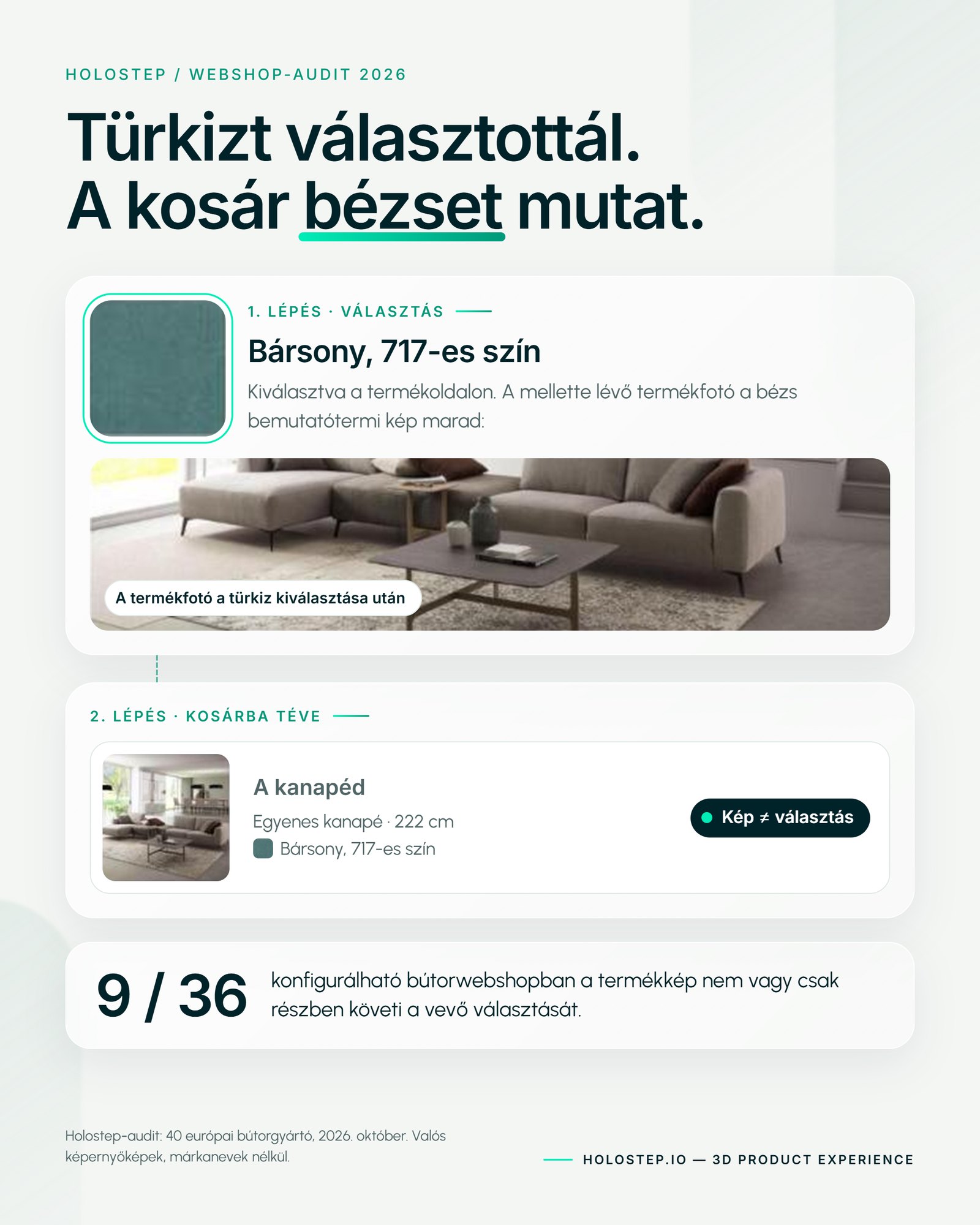
In such cases, the customer has to work out exactly what they configured from the image, the fabric swatch and the text summary. A default photo in the cart can add to this uncertainty, even if the listed options are otherwise correct.
Re-checking the detailed log identified a cart photo that differed from the selection in six cases. In one further case, the color selected on the product page was lost on entering a separate planner.
An important distinction
These are different issues: a default photo alone doesn’t prove a wrong order, and a lost selection signals a separate handover problem. The study didn’t check actual orders or production.
Holostep / Results
Of 40 furniture brands, only 8 journeys ran without obstacles
Each row builds on the previous one: it’s a narrower subset of the row above, and the number on the right shows how many journeys dropped out at that step. Most were lost at the end, on mobile. Of the 20 journeys, we recorded at least one mobile obstacle in 10 and couldn’t measure the mobile view in 2, so the final result is between 8 and at most 10.
Holostep / Mobile
On mobile, the option and the result must be visible together
Obstacles recorded in a mobile-sized browser included pop-up offers, hidden selectors and product images scrolled out of view. The 17 cases don’t mean 17 unusable webshops, nor 17 observed cart abandonments.
- Pop-up offersThey cover the selector or the product at the moment of decision.
- Hidden selectorsThe option exists, but a sticky bar or button covers it.
- Product image out of viewThe result of the choice is only visible after scrolling back up.
A long fabric list can work fine while the sofa preview stays several screens above. The shopper can pick a material, but only sees the result after scrolling back up. In the better-aligned solutions, the preview, price and confirm button stayed close to the selection.
Holostep / Next step
The next step can be the cart or a quote request
The coding table placed 27 examined journeys in the group that reached the cart; classifying some borderline cases more strictly would make it 25–26. We placed no orders, so this is not a rate of successful purchases.
In eight journeys, customization was followed by a quote request, a store locator or another sales follow-up. For custom furniture or furniture sold through a dealer network, this can be a deliberate business model. The question is whether shoppers understand the next step in advance, and whether the configuration is passed on with enough detail.
For the same reason, the presence of 3D visualization alone isn’t enough to judge the process. Half of the configurable journeys already had such a tool. Testing the full journey shows what happens to the selected color, size and configuration on the next screen.